

“Dyslexia, Art and School-based Trauma” By Dr. Neil Alexander-Passe
A personal Note
I don’t usually write about books.
But this one is different.
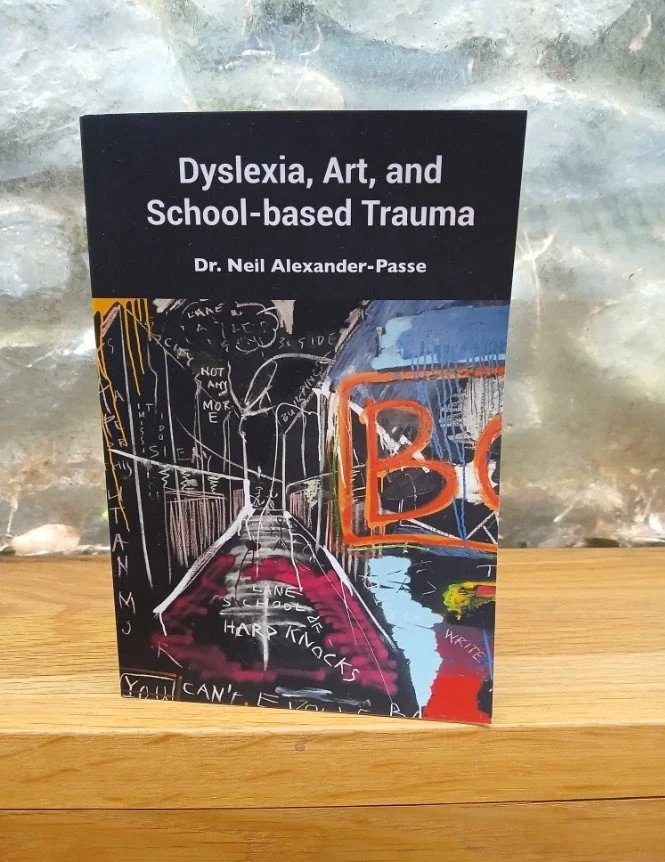
Dyslexia, Art, and School-Based Trauma by Dr Neil Alexander-Passe has just been published, and I’m honoured to be part of it. There’s a chapter in there about my work and my experience as an artist with dyslexia which is something that, for a long time, I didn’t really have the language to explain.
What makes this book even more special for me is the cover.
It features my painting Blackboard Jungle which is awesome to say the least!
The Classroom Never Really Leaves You
If you’ve experienced dyslexia, you’ll probably understand this without much explanation: school stays with you.
Not the facts or the lessons, but the feelings.
Confusion. Pressure. Being watched. Getting it wrong in front of everyone. Trying to keep up with something that never quite made sense, no matter how hard you tried.
For me, those experiences didn’t just disappear when I left school. They sank somewhere deeper. They shaped how I saw myself for years.
What Dr Alexander-Passe talks about in this book, the idea of school-based trauma, hits close to home. It’s not dramatic or exaggerated. It’s quiet, cumulative, and often invisible. But it’s real.
Finding Another Language
I didn’t turn to art because I thought I was “creative.”
I turned to it because it was the only place where things made sense.
Painting gave me a way to process what I couldn’t articulate. It wasn’t about spelling things correctly or following rules, it was about instinct, movement, feeling. Over time, I realised that what I had struggled with in school and that thinking differently, seeing things out of sequence, feeling things intensely was actually something that could feed my work.
The canvas became a space where those differences weren’t a problem.
They were the point.
Blackboard Jungle
When I made Blackboard Jungle, I wasn’t thinking about book covers or wider meanings. I was responding to something internal and something unresolved.
Looking back, it’s obvious what it connects to.
The blackboard is one of those symbols that sticks with you. Authority. Correction. Being measured. For some people, it represents learning. For others, it represents being exposed.
In the painting, it’s unstable. It’s chaotic. It refuses to behave (perhaps a bit like me as a kid in school!).
That feels more honest to me.
Seeing it now on the cover of this book is strange, but it also makes sense. The work was always about that environment, even if I didn’t fully realise it at the time.
Being Included in Dr. Alexander-Passe’s latest book on dyslexia
The chapter about my work isn’t just about art, it’s about the journey around it. The parts that don’t get shown. The self-doubt, the mislabelling, the long process of unlearning what you thought you were.
If you’ve ever been told - directly or indirectly - that you’re not intelligent, that stays with you. Even when you start doing something well, there’s a voice that questions it.
What I appreciate about Dr Alexander-Passe’s work is that it doesn’t just focus on difficulty. It also looks at what can come out the other side. Not in a simplistic “everything happens for a reason” way but in a more honest way.
Some people find a way to reshape those experiences into something else. And he gives a voice to those people through his book which is so important.
For me, that something was painting.
Why this matters to those with dyslexia
This book isn’t just for people with dyslexia. It’s about how systems can misunderstand people and what happens when they do.
There are a lot of people who went through school thinking they were the problem.
Some of them still do.
If this book helps shift that perspective even slightly, then it’s doing something important.
I’m grateful to be included in it.
And I’m glad Blackboard Jungle found its place on the front.
It feels like something has come full circle, taking a symbol that once represented struggle, and turning it into something that speaks back.
— Pigsy
You can get your copy of Dr. Neil Alexander-Passe’s book on Amazon now.
